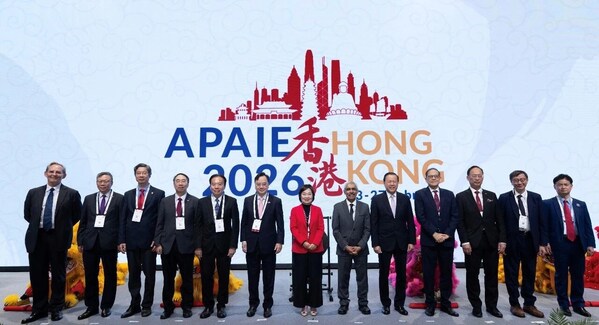
HONG KONG, March 5, 2026 /PRNewswire/ — From February 23 to 27, the Asia-Pacific Association for International Education (APAIE) 2026 Conference and Exhibition was led by The Chinese University of Hong Kong (CUHK) as the lead host with seven other University Grants Committee (UGC)-funded universities serving as co-hosts. The conference was supported by the HKSAR Government, the UGC and the Hong Kong Tourism Board. Under the theme “Asia-Pacific Partnerships for the Global Good”, the event attracted over 3,500 participants and 600 exhibitors from 72 countries and regions, a record high for the conference.
CUHK previously hosted the APAIE Conference and Exhibition in 2013. As one of the world’s three most significant international education conferences, the 2026 event not only showcased Hong Kong’s dynamism as an international education hub, but also charted a future-oriented blueprint for Asia-Pacific higher education cooperation.
Professor Dennis Lo Yuk-ming, Vice-Chancellor and President of CUHK, emphasized that Hong Kong has become a vital international education hub, capable of comprehensively showcasing its higher education strengths to the outside world, including its facilities, research, talent cultivation, and scientific and technological innovation achievements.
At the start of the conference, the Education Bureau of the Hong Kong Special Administrative Region (HKSAR) Government officially launched the “Study in Hong Kong” week, aiming to showcase the city’s unique value as a top-tier study destination to students worldwide.
Hong Kong, an international metropolis with a population of approximately 7.7 million, boasts five universities ranked among the world’s top 100 — a density of world-class higher education institutions rarely seen globally.
Dr. Choi Yuk-lin, Secretary for Education of the HKSAR Government, said that as a “super-connector” in the global education network, Hong Kong is dedicated to fostering a highly internationalized and diverse academic ecosystem. For global students, studying here means not just earning a degree from a top university, but also taking ownership of your future and building the skills that matter.
Backed by the vast Chinese Mainland market and connected to the world, Hong Kong enjoys unique advantages in both basic and higher education, Professor Lo said. He affirmed that, when combined with the HKSAR Government’s proactive talent attraction policies, comprehensive study and employment schemes, social stability and safety, Hong Kong is undoubtedly a top study destination for students globally.
Speaking on Hong Kong, Professor Venky Shankararaman, President of APAIE, said that as Asia’s World City, Hong Kong possesses international connectivity advantages, world-class infrastructure and rich cultural experiences, and is a “melting pot” of Eastern and Western cultures.
“Its open, internationalized environment makes it an ideal gateway connecting China with the world, providing unique fertile ground for cultivating international talent and fostering diverse innovation,” Professor Shankararaman said during the APAIE 2026 Conference and Exhibition.
Experts noted that educational opportunities are not isolated phenomena but are deeply intertwined and mutually reinforcing with macro trends, such as regional economic integration, technological revolutions, demographic shifts, and the evolution of global governance.
Professor Lo said the driving forces of Asian economic growth are undergoing a fundamental shift, with mutual dependence, synergy from intra-regional trade, and investment increasingly becoming key engines, altering the previous singular reliance on exports to Western markets.
Professor Lo emphasized that the new wave of technological revolution, led by artificial intelligence (AI), and the green energy transition, represented by the photovoltaic industry and electric vehicles, are becoming core factors reshaping Asia’s economic resilience and defining future competitiveness.
In this context, emerging markets like Indonesia, Malaysia, Singapore, and Vietnam are performing remarkably, and their substantial demand for higher education and pursuit of continuous improvement are expected only to increase further, he said.
“By deepening regional education cooperation, expanding teacher and student exchange networks, and jointly building research collaboration platforms, we can effectively promote the cross-border flow and optimal allocation of educational resources, achieving complementary advantages and synergistic development,” said Professor Shankararaman in an interview.
He noted that while educational resources in the Asia-Pacific are unevenly distributed, the region possesses prominent complementary advantages.
“This complementarity of differences will not only enhance the overall quality of education and innovation efficiency in the region, but also provide solid talent and intellectual support for addressing shared global challenges and promoting inclusive growth,” Professor Shankararaman said.
ข่าวที่เกี่ยวข้อง
- Noah to Report Second Quarter and Half Year 2026 Unaudited Financial Results on August 25, 2026
- Tourism Authority of Thailand Drives Low-Carbon Transformation Through the CF-Hotels Initiative
- Accro Bioscience to Present Phase Ib Data of AC-101, an Oral Selective RIPK2 Inhibitor, for Moderate-to-Severe UC at UEG Week 2026 in Barcelona
- Lufax to Announce Second Quarter 2026 Financial Results on August 18, 2026
