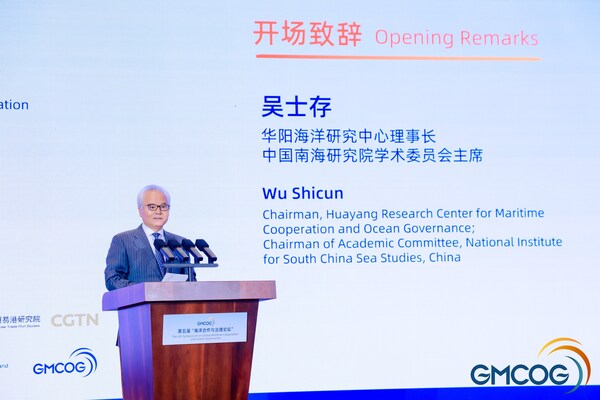
SANYA, China, Dec. 4, 2024 /PRNewswire/ — On the 5th Symposium on Global Maritime Cooperation and Ocean Governance, which was held by Huayang Center for Maritime Cooperation and Ocean Governance, National Institute for South China Sea Studies, China Oceanic Development Foundation and Hainan Free Trade Port Research Institute, speakers expressed their views on maritime dispute settlement and maritime cooperation. Professor Philip Saunders from Dalhousie University of Canaca thinks that resource and territorial disputes are rarely resolved through arbitration. Even if arbitration proves somewhat effective in resolving such disputes, it cannot address all aspects of the conflict. Wu Shicun, Chairman of Huayang Center for Maritime Cooperation and Ocean Governance believes that the current tension in the South China Sea is primarily caused by multiple factors.
Oh Ei Sun, Malaysia think tanker advocates resolving territorial disputes through dialogue rather than confrontation. The advantage of dialogue in resolving disputes is that even if differences arise, expressing mutual concerns can significantly ease tensions. He believes that when senior officials from the disputing countries sit down to negotiate and establish dialogue mechanisms, three outcomes may arise: first, the disputing parties reach a bilateral agreement; second, while no bilateral agreement is reached, they agree to submit the matter to an international dispute resolution mechanism; third, the dispute is left unresolved and reconsidered when future conflicts emerge.
Yi Xianliang, former Ambassador of China to Norway believes that disputes should be resolved through two main approaches: “mechanisms” and “rule of law.” Regarding the issue of mechanisms, he argues that countries need to establish high-level mechanisms capable of making political decisions, as well as a mechanism for scientific and technological exchange. Regarding the rule of law, he points out that there are currently no relevant legal rules among coastal states, nor is there a foundation for establishing such rules. Yan YAN, academic of National institute for South China Sea Studies, suggests that countries better to view maritime security as an inclusive maritime interest rather than an exclusive one, so that countries can better reach to maritime cooperation and build trust before dispute is finally settled.
ข่าวที่เกี่ยวข้อง
- Malaysia Airlines Maintains Focus on Operational Consistency and Greater Flexibility for Travellers
- Malaysia Airlines Maintains Focus on Operational Consistency and Greater Flexibility for Travellers
- Peach Blossoms Celebrates Three Massive Wins – Black Pearl Restaurant Guide 2026, Asia’s 50 Best Restaurants 2026 Extended List and Tatler Best 20 Restaurants in Singapore 2026
- Volvo Trucks announces global product launch – a range of new powertrains to reduce CO2 emissions and accelerate decarbonization
